European Founders in Japan Raise $1.2M to Develop Modular Humanoid Robots
Tokyo-based robotics company O-ID, founded by two European entrepreneurs, has raised $1.2 million in pre-seed funding to develop fully modular humanoid robots for industrial manufacturing and logistics.
Chicago-based TAWANI Ventures led the round, with participation from Hustle Fund, Techstars and several angel investors. The round also included the founders of Humanoid Guide, who were early investors in robotics company 1X.
Building Robots in Japan for the World
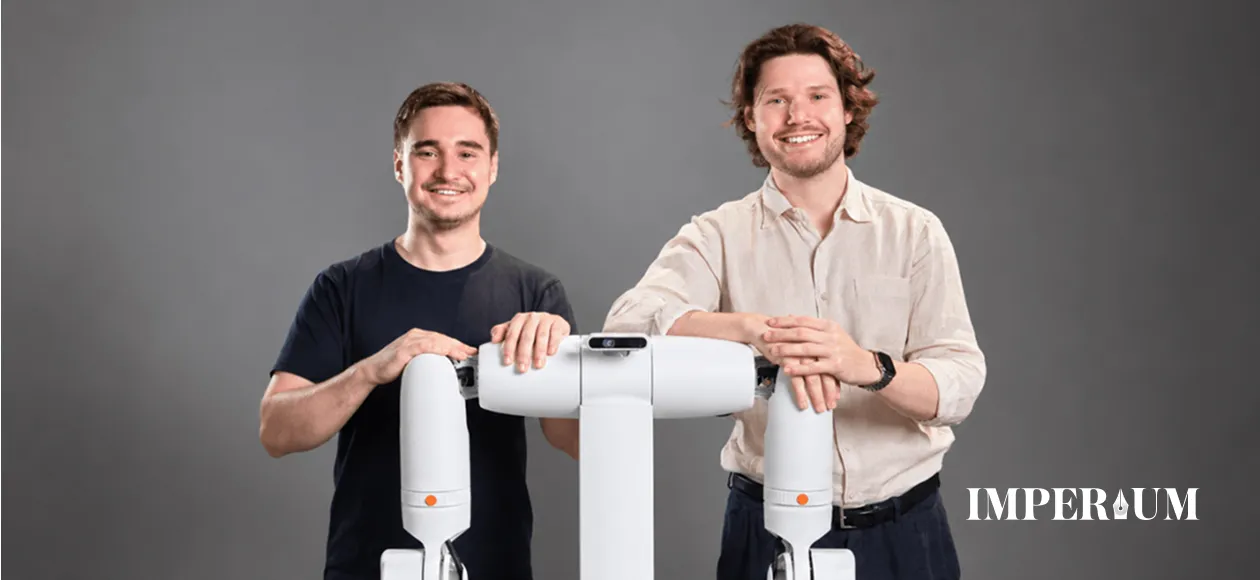
O-ID was founded in Tokyo in 2025 by Norwegian CEO Stian Jakobsen and Dutch CTO Simon Gormuzov, who met while studying at Waseda University. Jakobsen previously worked in cyber defence, while Gormuzov is a mechanical robotics engineer with several years of experience in industrial robotics. The pair later joined forces to build O-ID and develop humanoid robots for industrial applications.
I spoke with Stian Jakobsen, Co-Founder and CEO of O-ID, to learn more about the technology, the company's decision to build in Japan, and its aims for modular humanoid robotics.
According to Jakobsen, the duo came to Japan for different reasons but stayed because they saw an opportunity to build something that matters.
“Simon came for robotics; I came to study cybersecurity. We became friends, and we kept talking about how much more these machines could do.
We both love this country, and living here makes the workforce challenges very real. At the same time, Japan has incredible engineers and manufacturers, some of whom could both make components for our robots and use them in their factories.
We want to bring those things together and build robots here for the world.”
Japan’s $65B Physical AI Push Meets an 11 Million-Worker Shortfall
Japan is facing a major workforce challenge as its population ages. The country is expected to have a shortage of more than 11 million workers by 2040, with many factory workers retiring without enough younger workers available to replace them.
At the same time, Japan is making robotics a national priority. In June 2026, the country announced plans to attract ¥10.5 trillion ($65.1 billion) in public and private investment in “physical AI” — AI systems that control robots and machines. Japan aims to deploy 10 million AI-powered robots by 2040.
Traditional industrial robots are often designed for specific tasks, meaning factories may need significant time and investment to adapt their facilities when deploying them. General-purpose humanoid robots offer greater flexibility, but their complex systems can also make repairs difficult. If a single component fails, the entire robot could potentially be taken out of operation.
The cost of downtime is especially significant for large automotive factories, where one hour of production disruption can cost millions of dollars.
O-ID Brings Modular Humanoids to Japan’s Factory Floors
O-ID is developing humanoid robots designed with a cybersecurity-first approach that allows them to operate within existing factory layouts without requiring major facility changes. The company believes its modular design can also make humanoid robots easier and more affordable to maintain as they are deployed at scale.
The robots use onboard AI sensors to continuously monitor the condition of their components and identify parts that may be nearing failure. This could allow O-ID to prepare and ship replacement components before a breakdown causes significant downtime.
When asked whether Japan has fallen behind in humanoid robotics, O-ID CEO Stian Jakobsen said the country still has work to do in commercialising the technology. However, he believes Japan’s strong manufacturing industry could give it an advantage as humanoid robotics moves toward wider industrial use.
“We’re talking to manufacturers that have spent decades producing precision components for the automotive industry. The factories, equipment, and expertise already exist.
We don’t need to build all of that from scratch. “Our opportunity is to bring that manufacturing strength into robotics and move quickly. We’re not building this just to make a few impressive machines.
We want to build one of the world’s leading robotics companies, and we believe Japan is the place to do it.”
Jakobsen said the company's broader motivation is tied directly to Japan's labour shortage:
“When enough factory roles go unfilled at once, entire supply chains are at risk.
O-ID's robots are built to work alongside the people still on the floor, closing those gaps before they become a crisis for a single factory and for the industries Japan depends on.”
Why a humanoid rather than conventional automation?
For O-ID, the case for humanoid robots is less about replicating the human form and more about fitting into factories and processes originally designed around people.
Across the hundreds of thousands of manufacturing sites in Japan, Jakobsen noted, much of the work has been designed around the human body: “the height of a table, where the tools are, how someone reaches into a machine.”
He explained:
“Conventional automation can work extremely well, but fitting it into an existing process can mean redesigning workstations, moving equipment, and changing how the line runs. That takes time and money.
We want robots that can work in those existing spaces, use the equipment already there, and work alongside people.
The point isn’t to make something look human. It’s to supplement a workforce that’s increasingly difficult to fill, without asking a factory to rebuild around the robot.”
From Prototype to the Factory Floor
O-ID’s first prototype is a fully assembled, stationary robot with two arms. The company is using it for integration testing and to develop the manipulation skills needed for its first customer applications. A second version is already in development and will feature greater mobility and strength.
O-ID plans to showcase the new version at CES 2027, with the first factory pilot projects expected to begin in early 2027. According to Jakobsen, the company is currently focused on making sure the robots can perform customer tasks consistently, meet safety and reliability requirements, and be manufactured and serviced at scale.
The company is initially targeting repetitive factory tasks that are still challenging to automate, including loading and unloading materials and moving components between different stages of production.