Plymouth-based Oshen raises €4.27 million to scale autonomous robot swarms for ocean monitoring
Oshen, a Plymouth-based robotics company developing a persistent sensing layer for the world’s oceans, has raised €4.27 million ($5 million) in a fresh funding round. The company is also tripling its manufacturing capacity to meet growing demand from navies, weather agencies, and ocean scientists.
The funding round was led by Lunar Ventures, with participation from AlbionVC, Twin Track, and Concept Ventures. Angel investors also joined the round as advisors.
“We’re making the ocean’s eyes and ears, and we need a lot of them. Seventy per cent of the planet is ocean and we can barely see any of it in real time. That’s not a sensing problem any more – the technology works, and it works in the worst conditions on Earth. It’s a manufacturing problem. So we’ve spent the last year turning C-Star production into something closer to a fast-food kitchen than a shipyard: fast, repeatable, and something you can stand up anywhere,” said Anahita Laverack, CEO and co-founder of Oshen.
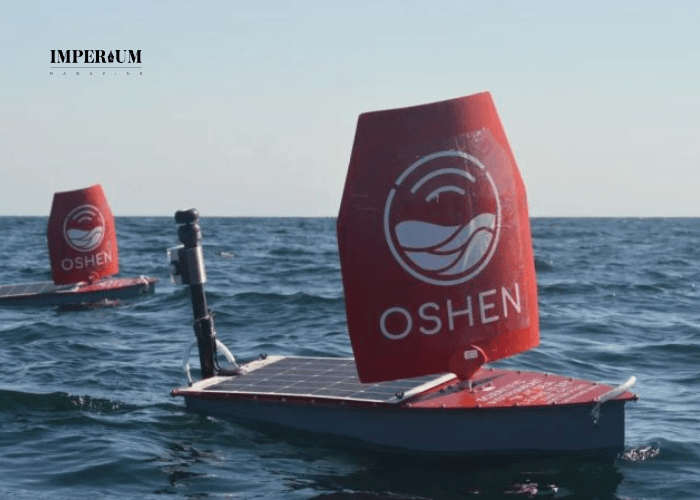
Founded in 2022 by Imperial College engineers Anahita Laverack and Ciaran Dowds, Oshen provides wide-area ocean intelligence through constellations of autonomous C-Star robots. These small, wind- and solar-powered robots work together to continuously monitor large areas of the open ocean.
According to Oshen, navies operate a limited number of extremely expensive ships and spend significant time monitoring submarine activity across areas such as the North Atlantic. Oshen aims to complement this approach with thousands of low-cost, expendable, mass-produced robots.
Each C-Star is a 1.2-metre wind- and solar-powered robot that can be carried and launched by a single person from almost any boat. The robots can operate for months without maintenance, send data via satellite, and work in groups. Dozens of C-Stars can cover hundreds of miles of ocean or gather in a specific area when closer monitoring is needed.
In September 2025, three C-Stars operated under a contract with the US National Oceanic and Atmospheric Administration (NOAA) and intercepted Hurricane Humberto north of St Thomas in the Caribbean. The robots entered the storm’s eyewall while it was classified as a Category 5 hurricane. Oshen says this was the first time an uncrewed surface vessel had achieved this, with the collected data contributing to the National Hurricane Centre’s official forecast discussion.
For security applications, C-Stars can provide continuous, low-cost monitoring in areas where ships may switch off their transponders to move sanctioned oil, uncrewed vehicles operate near critical cables and pipelines, or illegal fishing and drug trafficking take place.
The technology also has applications in weather forecasting. Since ocean heat is still not measured in enough detail, collecting more surface data could help identify rapid hurricane intensification earlier and give authorities more time to issue evacuation warnings. As C-Star networks grow, the data could also support better seasonal weather forecasts and, eventually, climate projections.
Oshen says its customers and partners include the US Navy’s Naval Meteorology and Oceanography Command, the Royal Navy, NOAA, the Met Office, Météo-France, and Sweden’s ocean-monitoring organisation VOTO.
The company has also significantly increased its manufacturing capacity. It took Oshen three years to build its first 15 C-Stars, but it can now produce 15 every six weeks. A standardised manufacturing system allows new technicians to assemble the robots in less than 30 minutes, making the process easier to replicate across multiple locations. The company has also received orders for another 100 C-Stars.
With support from the UK’s Defence and Security Accelerator, Oshen is testing C-Stars as part of a distributed passive acoustic network alongside ZeroUSV and MarineAI. The project includes what Oshen describes as the first autonomous launch of C-Stars at sea from an uncrewed mothership.
Oshen is also deploying a 50-robot constellation in the North Atlantic Subpolar Gyre through a €2.3 million (£2 million) project funded by the Advanced Research and Invention Agency (ARIA). The project aims to develop an early-warning system for a potentially significant climate tipping point.
The company plans to use its new funding to expand manufacturing and develop three areas where demand is growing fastest: passive acoustic systems for ship detection, protection of critical subsea infrastructure, and anti-submarine warfare.
Oshen’s longest single mission has lasted eight months, while its C-Star constellations have operated across six countries. The company offers the technology through three business models: data-as-a-service, vessel leases, and direct sales of complete constellations.
“There is a version of the next decade where the ocean stops being a dark spot. Not because of one clever sensor, but because there are thousands of cheap robots out there, all the time, telling us what’s actually happening. This is our goal at Oshen. We’ve done step 1 — make world-class robots that have achieved world firsts — now it’s time to see the impact a hundred of them can have,” added Laverack.