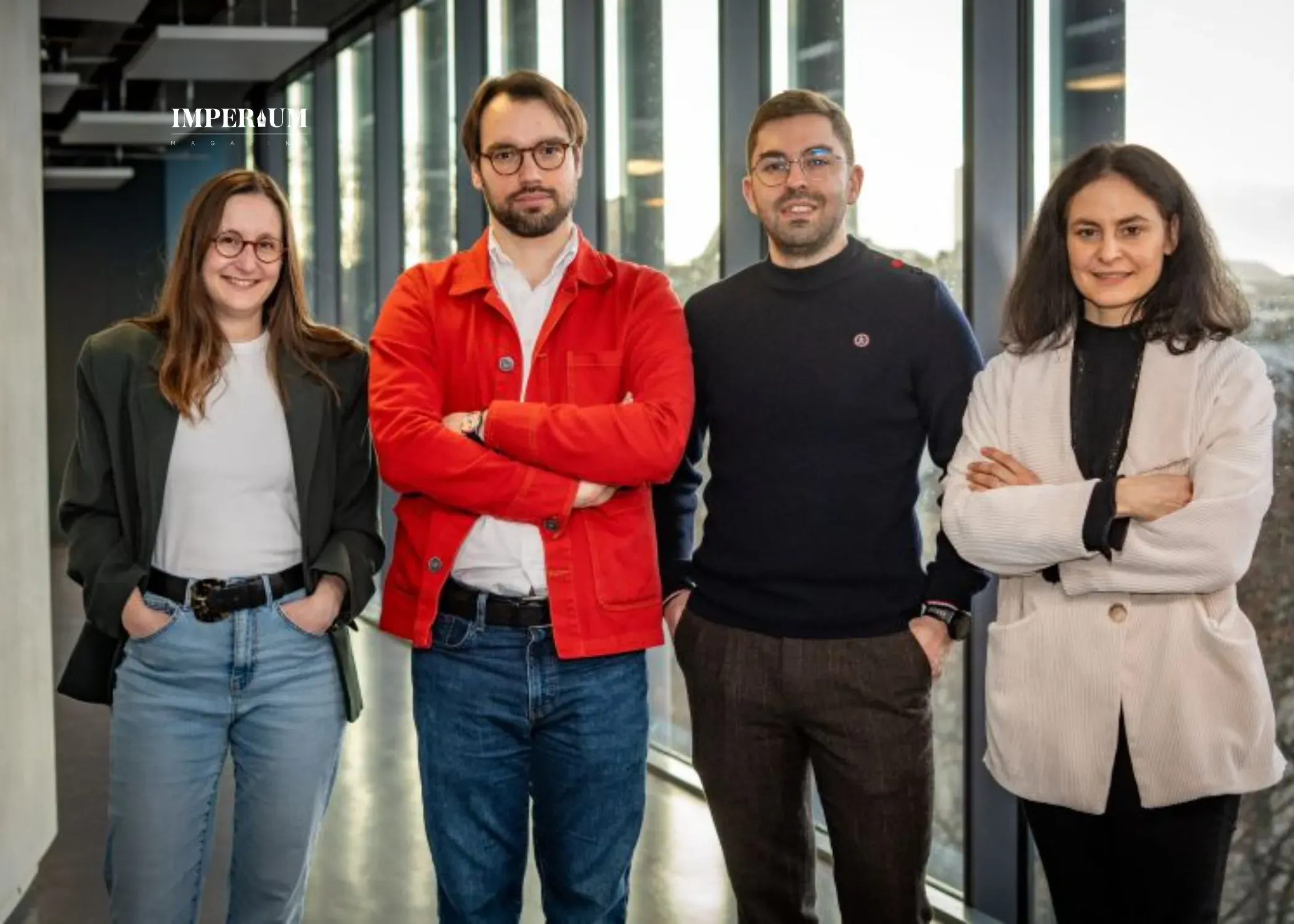
Qluster secures €4.7M to advance next-generation quantum computing technology
Paris-based quantum computing startup Qluster has secured €4.7 million in a pre-seed funding round led by Quantonation, a venture capital firm focused on quantum technologies and physics-based innovations, with additional participation from Quantum Launchpad and Bpifrance.
Spun out of Laboratoire Kastler Brossel, a renowned research institution associated with three Nobel Prizes in Physics, Qluster was established by David Fainsin (CEO), Ambroise Boyer (CTO), Clarisse Thibault (COO), and Valentina Parigi (CSO), a physicist and professor at Sorbonne University. Drawing on decades of foundational research in quantum optics, the company is working to build a new generation of quantum computing systems.
Qluster's long-term ambition is to create a universal, fault-tolerant quantum computer capable of solving complex industrial problems. Its technology combines continuous-variable photonic quantum computing with an "Architecture First" methodology, which focuses on the computational demands of real-world industrial applications rather than being restricted by the technical limitations of a specific qubit technology.
The company's approach relies on light to process quantum information, supporting the development of quantum computing architectures designed to improve scalability and operational stability. Its technology is based on a patented miniature photonic source developed by Parigi and Fainsin at Laboratoire Kastler Brossel. The underlying concept has already been experimentally demonstrated and documented in a peer-reviewed scientific publication.
In addition to its photonic computing technology, Qluster follows an "Architecture First" development strategy that begins by identifying the computational challenges businesses want to address. The company converts these requirements into quantum circuits and evaluates the resources needed to execute them, including qubit numbers, circuit depth, processing speed, and energy consumption. Based on these technical requirements, Qluster then designs the underlying quantum computer architecture to deliver solutions aligned with practical industrial needs.
For several years, the race to build quantum computers has largely focused on developing increasingly powerful qubits. But the challenge today is to ensure that the computing architecture can meet the needs of industry. This is the approach Qluster has adopted from day one, with the goal of developing an intermediate-scale quantum computer by 2032,
explains David Fainsin, co-founder and CEO of Qluster.
Despite being established only a few months ago, Qluster has already achieved significant recognition by winning the 2026 i-Lab Grand Prize, an initiative supported by the France 2030 investment programme. Since its launch, the startup has also received backing and guidance from Quantum Launchpad and Agoranov, helping it advance its early-stage research and technology development.
Looking ahead to 2036, Qluster aims to build a large-scale, universal, fault-tolerant quantum computer capable of handling complex industrial computations while maintaining commercially practical requirements for system size, energy consumption, and operating expenses. The company wants to make advanced quantum computing more accessible to industrial applications by developing technology that balances computational performance with operational efficiency.
To support its ambitions, Qluster plans to establish its own research and development laboratory to further enhance the capabilities and performance of its photonic technology. It also intends to strengthen its workforce by recruiting experimental physicists and experts in quantum computing theory and architecture. These new hires will enable the company to pursue hardware innovation and the development of its future quantum computing architecture simultaneously, accelerating progress towards its long-term technological goals.